Helicopter counseling feels like helping, but it leaves students without agency. Learn how to shift advising so students lead their own postsecondary journey.
AI Optimism Needs a Reality Check
AI is projected to create more jobs than it displaces, but many students graduate from high school without a career plan or the skills to step into those roles. Closing that gap takes connected pathways in schools: career-connected learning, early credential access, and strong advising. Employers have a role too, through partnering with schools, mentoring students, and investing in the pipeline they’ll depend on.
AI Will Create Jobs.
Who Will Be Ready for Them?
I keep finding myself in the same conversation.
A room full of CEOs, Fortune 500 types, serious people with power, all talking about the future of work. The mood is bullish. Someone makes the case that the doom-and-gloomers have it wrong, that yes, AI will displace jobs, but it will create even more. They’re not wrong. The World Economic Forum’s Future of Jobs Report projects that while AI will displace 92 million jobs, it will also create 170 million new ones. The opportunity is real.
But every time I hear this optimism, I feel compelled to ask the question nobody in the room seems to be asking: “And who, exactly, is preparing our kids for those 170 million new jobs?”
The Talent Pipeline Is Leaking
Here’s what I know from working inside the education sector: the system that is supposed to build that talent pipeline is leaking. Most young people feel pessimistic and underprepared for life after high school. Over 1/2 say they are “suffering or struggling” after graduation, and 45% describe the job market and support systems as “broken.”
The inability to prepare young people for the work of the future is not a failure of will on the part of our educators. The absence of meaningful employer engagement, outdated policies on resource allocation, and chronic underfunding have created friction that makes operating at the speed of workforce change extremely difficult. Thus, every year, millions of American students graduate from high school with a diploma and not much else… no understanding of the labor market, no clear educational pathway, no transferable college credits or work-based certifications, and, most notably, no real sense of what they want to do and if that career path is reliable in today’s economy.
Students Want a Plan
but Don’t Feel Ready to Make One
An estimated 85 percent of good jobs, meaning those that provide a living wage and a path to economic stability, will require a postsecondary degree or a specialized credential. The World Economic Forum estimates that 39% of core job skills will change by 2030, with analytical thinking, AI literacy, and creativity identified as the most critical capabilities. These aren’t electives. They’re survival skills. And yet, while 78 percent of Gen Z students say it is vital to have a career plan before high school graduation, 13 percent feel prepared to make one.
Connected Pathways
Work Better Than Loose Strategies
So what can we do to prevent the looming workforce talent crisis?
For high schools, the answer lies in an essential mindset. High schools need to shift their center of gravity toward students’ long-term success, satisfaction in life and work. This requires us to redesign the experience by implementing a cohesive system of pathways development that integrates career-connected learning, accelerated course and credential access, and high-quality advising that supports every student. While many schools implement aspects of this system, few do so comprehensively. Supports tend to operate in isolation from one another and without the structures and tools that ensure they are happening with quality for all students.
When we talk about preparing students for life after high school, we tend to rely on a loose collection of strategies that aren’t well-connected to one another. Advanced coursework sits in one hallway, hands-on experiences in another. Some students land an internship.
Everyone gets a few minutes with a school counselor who is, on average, responsible for 372 students at a time. What’s missing is the connective tissue that binds it all together, a coherent set of interventions that ultimately builds clarity on occupational purpose, sense of belonging and social capital. These are the right ingredients. Without coherence, they don’t add up to much.
As the co-chair of the Commission on Purposeful Pathways, I joined dozens of leaders in education, policy, and business to explore this challenge. We authored A Launchpad for Life to offer a concrete framework with actionable guides for rethinking how schools, higher education institutions, and workforce leaders can work together to close the gap.
What Employers Can Do Now
Many businesses continue to treat workforce preparation as someone else’s problem…it is a higher ed problem. It is a school problem. It is a policy problem. It’s also yours. The talent you will need in five, ten, and fifteen years is sitting in classrooms right now. If those classrooms aren’t evolving into spaces where students are building agility, creative thinking, and other skills they’ll need to work alongside AI, your optimism about job creation becomes a promise you can’t keep. Workers with advanced AI skills already command wage premiums up to 56% higher than their peers in the same roles. The economic signal could not be clearer.
Getting involved does not require starting from scratch. The Commission on Purposeful Pathways report offers a blueprint for how employers can be co-architects of the pipeline. That means partnering with schools on structured, time-bound challenges that give students real problems to solve and real people to call with questions. It means sponsoring near-peer mentorship. It means bringing your voice to the policy table. And if you aren’t able to do the work yourself, write a check for those of us who will. Treat investment in education, and specifically advising, workforce prep, and pathways creation, as what it actually is: an investment in your own future.
AI will reshape the economy. That much is settled. The question is whether the students moving through our schools right now will be ready to participate in it, and whether the adults responsible for both educating them and hiring them will build that future together rather than waiting for someone else to do it first.
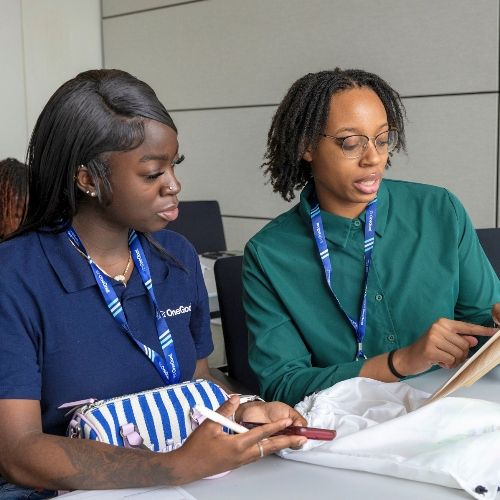
Melissa Connelly is the Chief Executive Officer of OneGoal. As a first-generation college graduate, Melissa’s path to and through college was not easy. She started high school in a truancy program, but with the support of caring educators, she went on to obtain three higher-education degrees with a 4.0 GPA. Melissa has spent more than 15 years in education, leveraging her experiences, empathy, and drive to make certain her accomplishments are not an anomaly but the norm for underserved youth.

Related Stories
Discover how states are strengthening high school accountability and postsecondary planning to ensure all students graduate ready for life after high school.
High schools should shift to a whole-school “Guidance Culture” with postsecondary planning in everyday lessons.