


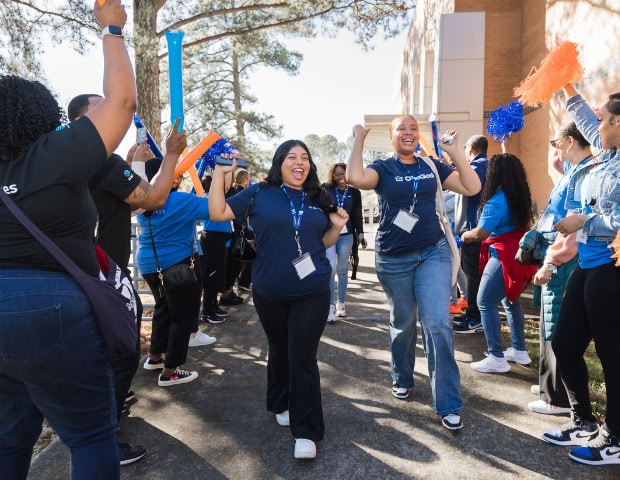
Hosting career fairs can be a powerful opportunity to connect students to a wide range of career possibilities.
Filter By |
10 Tips to Help Students Thrive After High School
By David Soto
December 10, 2025
The transition from high school to postsecondary life can be overwhelming for students. Whether they’re pursuing college, a vocational program, or joining the workforce, educators play a crucial role in guiding them through this transition. This post offers 10 practical tips to help educators support students as they take their next steps with confidence.
Key Takeaways
- Develop Skills and Build Resumes Early – High school is the ideal time for students to identify and practice both soft and hard skills. Educators should encourage resume-building activities, self-reflection, and elective choices that align with students’ goals.
- Connect Students to Support Systems – Students should learn how to find and utilize academic, social, and professional support systems in college or the workplace. This includes resources related to accessibility and mentorship.
- Encourage Family Involvement and Conversations – Early and open dialogue with family members about college, finances, emotional challenges, and expectations can strengthen a student’s support network and readiness for the transition.
- Promote Routine, Initiative, and Problem-Solving – Establishing consistent routines and taking initiative are key to success in postsecondary environments. Educators should model problem-solving and help students develop autonomy in managing responsibilities.
- Foster Forward Thinking and Career Exploration – Students thrive when they engage in early planning and hands-on experiences related to their interests. Programs like internships and mentorships give students insight into potential career paths.
Tip 1
Proactively Build Resumes
During a student’s time in high school, they have developed a list of soft and hard skills that they should feel comfortable using and speaking about on things such as personal statements, resumes, cover letters, job interviews, or every day professional interactions. Early on in high school, students should be thinking about what skills they are most adept at to further develop, or consider what class offerings can prepare them by teaching hard skills that make them more marketable to employers or programs.
Most students are able to list some of their skills in a vague manner, without any deep explanation, but few students can give examples of when they used or learned skills and how they could apply them in other academic or professional situations. The first time I had a real resume workshop as a student was my freshman year of college. I learned quickly that my resume was a work in progress, but I also realized I did not spend enough time thinking about my resume and how to market myself for college or job searching. Teachers can help students strengthen their soft skills, but resume workshops and tips for writing resumes, even looking at student sample resumes, will benefit students who have yet to spend time creating their resume.
Hard skills are specific, teachable abilities or knowledge that is more measurable and applicable to specific jobs than soft skills. High school students can form hard skills, whether through course selection or from life experiences outside of the classroom, such as job experiences. Hard skills including print design, coding, data analysis, marketing, video editing, writing, and other skills can be picked up in class offerings in high school.
Skills for College and Career Readiness
Teachers should advise students to consider what electives they could be taking in junior or senior year to get a head start at their professional growth after high school.
- Is communication a top skill of any of your students?
- Can they articulate, speak clearly or relatably?
- Can they speak about a time when they used their communication (whether written, verbal, or visual) on a project or in their job?
The idea is not to just list your skills, but to be fully aware of them and yourself.
Tip 2
Find Support Systems
For Your Students
Educators could spend time in class going over the types of support systems colleges present for students in their school and career path. One of the biggest mistakes a student can make is to endeavor on a new life path and think they can do so without finding their new support systems. If a student is living or commuting to campus, they should get involved on campus to some extent. This can take the form of clubs or political organizations on campus, attending community events with friends, joining ministry or church organizations, or simply utilizing the academic support systems on campus like tutoring, writing workshops, events for commuter students, or spending time with advisors. In work communities, students can find people with shared interests, or find relatable supervisors and senior employees to learn and take direction from to get the best understanding of the work culture and standards.
College Resources for Postsecondary Success
Many colleges, universities, and worksites are committed to values such as equity and inclusion, and high school students would greatly benefit from learning what supports these institutions provide to ensure all students’ transitions are fruitful. Direct students to explore college websites with search terms such as ‘center for accessibility resources,’ ‘disability resource center,’ or ‘office of diversity, equity, and engagement.’ Students will find that schools maintain a serious commitment to making students feel a part of the larger community, with a genuine sense of belonging through engagement.
For students with more specific needs, many government entities such as the Illinois Department of Human Services (IDHS) provide Transition Services for Youth with Disabilities during their time in high school and after. I encourage educators to discover what local and state support systems exist for their students. IDHS provides pre-employment services that include job exploration counseling, work-based learning experiences, counseling on postsecondary education, workplace readiness training, and instruction in self-advocacy.
Tip 3
Professors Are Often
Students’ First Allies
Not utilizing the help and guidance of professors is one of the most frequently lost opportunities for college students. The mentorship that comes from professors or instructors is often what students need to get through the new productive struggles they encounter. Help from professors can come in the form of academic guidance, class choice selection, informing students of different routes to finishing their program, tips on major-related scholarships, finding school-sponsored events, or even discussing the content to help students better understand it and do well in courses. Visiting a professor during their office hours may seem scary or unnecessary to students, but it is the type of exciting first step we need to prepare students to take for themselves.
Professors, mentors, and instructors will quickly become the first to speak positively on a student’s behalf in letters of recommendation or referrals, so frequent interactions with them matter. Professors will quickly fill in the mentorship role that high school teachers used to fill and they will be the ones to help propel students in the direction of achieving their aspirations.
Tip 4
Have Family Conversations
Early and Often
College visits were an exciting, bonding experience among my mom, younger sister, and me. We all shared in the wonder of what my life could look like for the next four years. As a first-generation college student, stepping foot on a college campus or standing in a historical college building was a shared first experience for all of us. There is an exciting sense of hope knowing that you are making a major life decision with the blessing of your parents, siblings, or guardians. These visits sparked deep conversation about what to be prepared for in the near future, including the challenges and blessings I was going to face. But students don’t face challenges alone; their parents, friends, and family also take on the burdens that their students face.
The guidance and knowledge we give students in the classroom should flow to their parents and families as well. A lot of this information is new for everyone, so conversations about commonly faced issues such as financial constraints, preparation for academic rigor, navigating college culture, balancing work responsibilities, or what to do when you need emotional support must happen early. Success favors those who are prepared, and preparation means knowing your obstacles and how to overcome them.
Emphasize Financial Aid and Scholarships
- Educate students and families about financial aid opportunities. Help them complete the FAFSA and apply for scholarships.
- Encourage students to apply for both national and local scholarships to maximize their funding opportunities.
- Utilize OneGoal’s FAFSA blog post for common challenges families experience with FAFSA.
Not all students have the same support systems when they make major life transitions, and sometimes students do not have any familial support. Teachers can only do so much when it comes to filling gaps in support, so programs like OneGoal that offer guidance for a student’s first year after high school can help our students in their time of need.
Tip 5
Emphasize Routines
Major changes in someone’s life path are often followed by new routines. Routines are not just for the purpose of being productive, though. A routine can keep you on track just as a schedule can keep you on time, but routines can also keep you centered, grounded, and in the right headspace. The structure that comes with a routine provides daily predictability, which can comfort and alleviate much of the stress that comes with a fast-paced work culture. In high school, students are prepared to meet wake-up times, deadlines, and expectations laid out in rubrics for assignments, but students are not prepared to do something like plan out their entire day to meet all of their personal, academic, work, or family obligations, so students should gain experience prioritizing what benefits them in a standard routine.
What can teachers do? First, model realistic routines in class and gradually reduce teacher guidance so students can learn the routine on their own. Teachers could also share tips that help them personally, like finding study spaces where you are most productive, spending study time with like-minded people who share similar goals, defining what rest really looks like, and being critical of how you spend your time. A business mentor of mine had a lifelong motto of “time is money” and though I always thank him for his guidance, I’ve learned time is far more valuable, so it matters how we spend it.
Tip 6
Promote Forward Thinking
and Postsecondary Planning
You can never start planning for the future too early. The students who are prepared in their next steps walk with a confidence that bleeds into their everyday responsibilities. An example of this early planning can be seen in one of my OneGoal Fellows, Alex. Alex was already interested in the medical field when I had him as a student freshman year. He learned about a medical program for Hispanic high school students provided by The University of Illinois Chicago. His application to the Medical Apprenticeships Academy Program (MAAP) required one letter of recommendation, a one-page written response to a prompt, and a virtual interview in which he answered questions about why he was interested in the medical field. After he was selected, he attended an orientation with high school sophomores, juniors, and seniors in the program.
Alex says he learned necessary life and college skills like managing time with the work he does in the program and in high school. He commits to meeting two Saturdays a month, about 4-5 hours each time. The program sessions cover topics such as medical-related content, culture and community in college, trends in higher education, the college search process, and the Hispanic pipe leakage (the high dropout rates of Hispanic students in college). Alex has also done career-related skill-building in the program such as performing dissections and stitching plastic skin molds.
Another student of mine, Nathan, who is also a OneGoal Fellow, has joined the Chicago Police Fire Training Academy (CPFTA ). He was introduced to this program by his mom, who knew her son was already interested in these careers. He joined the two-year program his junior year of high school and commits to meeting every Tuesday and Wednesday during the school year. The program includes physical training, learning how to use handcuffs and batons, and presentations by current police officers and firemen in the field. He said the biggest benefit of the program is the opportunity to get a glance at what these careers really look like. “The more they show you,” Nathan said, “the more you feel ready to work with your hands in the job itself.” Teachers should encourage students to explore their interests, discover their strengths, and spend time planning and preparing for their success through similar programs.

Tip 7
Take Initiative
Educators give students the right kind of push they need to take action. In our absence, we want our students to make decisive moves on their own. How can we prepare students to take action? Well many of us are already doing that. We encourage curiosity. Curiosity sparks initiative. We provide opportunities for student voice, choice, and autonomy. We present real-word problems and ask for, not always give, solutions. We create opportunities for independent and collaborative work because both are inevitable. We tie our lessons to the real-life goals of students and we make meaningful work. Building lessons around initiative isn’t always easy and it sometimes requires extra work on our end, but in doing so we are modeling initiative to our students.
In essence, put the ownership on the students to do what is best for them. Give guidance, direction, and knowledge, but ultimately prepare them to make judgments on their own. I have seen other educators model initiative in my school through requiring students to ask for letters of recommendation early on in their junior year as a grade, drafting personal statements, and doing major history research projects their sophomore year that prepare students to access databases, read peer-reviewed articles, and use evidence to create a finished product like a paper or a website.
Tip 8
Prepare Students
to Be Solution Finders
Asking for help is always encouraged, but receiving help is never guaranteed. Students should be prepared to find solutions on their own. When using new platforms, websites, and computer programs, students should get used to spending time learning and navigating them, and not wait until help is provided. Students should be prepared to send emails or make phone calls when they need to. They should be ready to reach out to a college or a future or current employer. If students apply to a desired job but do not hear back soon, they can call the employer to introduce themselves formally.
The following are questions educators should have their students consider:
- What do students do in the event of miscommunication between coworkers, colleagues, professors, or managers?
- How do students resolve scheduling conflicts or performing poorly in a class or on the jobsite?
- How do students successfully schedule courses to stay on track to graduate?
- What training is necessary to get a desired position?
- How do our students stay on top of making important payments?
- What do students do if they don’t feel prepared to tackle the academic rigor they are currently facing?
- How do students manage all their commitments?
Learning to problem-solve on one’s own is invaluable. But of course, part of problem-solving is learning how to ask for help. This is always encouraged.

Tip 9
Connect Students with
Mentors, Alumni, and Institutions
The connection between our students and others who have walked similar life paths and faced a variety of obstacles is important because it provides students a sense of self-efficacy and removes some uncertainty about what they can achieve. New voices give more authority.
Teachers and schools can do the following:
- Organize mentorship opportunities and alumni panels. Hearing firsthand experiences from others who’ve navigated similar paths can be incredibly motivating for students.
- Emphasize the importance of college visits, whether as school field trips or scheduled on the students’ own time.
- Host college and career fairs to connect students with new opportunities.
- Stay in touch with your students after they graduate. Encourage students to reach out with updates and to stay connected with any new information to pass on to future students.
Tip 10
Remember the Entrepreneurial
Spirit Is More than Business
America’s work culture has long celebrated the entrepreneur, but the entrepreneurial mindset is useful far past the goal of just making money. When I think of entrepreneurship, I think of a business, calculated risks, and returning profits. There is great value in educators emphasizing the approach of operating our professional lives in a similar way–a business that is constantly seeking growth. Teachers can model and speak of the value of these qualities:
- Seek opportunity. Opportunity will present itself to all, so students should be prepared to snatch it when they see it.
- Build and sustain relationships. They should also seek and sustain professional relationships with co-workers, colleagues, professors, and supervisors.
- Stay fully encouraged. There should be no discouragement in a failed attempt or missed opportunity. Failure produces valuable experiences, and a closed door does not mean rejection.
- Work ethic matters. Hard work is seen and it is valued.
- Always seek knowledge. Knowledge is always an asset, so whenever possible, both academic and labor-related knowledge should be picked up. It can only benefit our students.
Conclusion
By following these 10 tips, educators can help students transition smoothly to life beyond high school. Every student’s journey is unique, but with the right guidance and support, they can achieve their full potential.
Q&A
What are some ways educators can help students explore postsecondary opportunities?
Educators can introduce students to programs, internships, and mentorships that align with their interests, as well as help them research college options, scholarships, and career pathways early on.
How do mentors and alumni contribute to a student’s success after high school?
Hearing real-life experiences from mentors or alumni can inspire students, reduce their uncertainty, and provide valuable advice. Schools can facilitate these connections through panels, networking events, and ongoing relationships..
Why is it important for students to visit professors and use office hours in college?
Professors can become key mentors by providing academic support, providing guidance on course and career choices, and writing letters of recommendation. Building relationships early helps students feel supported and engaged.
How can students become better problem solvers in college or the workplace?
By learning to seek information independently, ask questions, use digital tools effectively, and communicate clearly with professors or supervisors, students become more resourceful and self-reliant in facing challenges.
David Soto has been a Chicago resident his entire life. From being a Chicago Public Schools student, to attending both Saint Xavier University to the University of Illinois at Chicago, David has always been deeply devoted to Chicago. He is currently teaching high school history in the IB program and is a OneGoal Program Director at Prosser Career Academy. He sponsors and leads the Student Voice Committee at Prosser, which continually inspires him as a community member.
Related Stories
Mentorship is essential in helping students overcome the academic, social, and emotional challenges of transitioning to college—especially during the critical first year, when many students are at risk of dropping out.

This blog post explores effective strategies and insights to inspire and support individuals in pursuing and persisting on their postsecondary path, ultimately helping them achieve their academic and career goals.